
On this page
Land acknowledgement
We have prepared this report in the Ottawa-Gatineau region, the traditional territory of the Algonquin Anishinaabeg peoples. They have lived on this territory for millennia. Their culture and presence have nurtured this land and continue to do so. The Tribunal members and staff honour all First Nations, Inuit and Métis peoples of Canada, their valuable past and their ongoing contributions to the land that we all share.
We invite you to join the journey to reconciliation and to learn more about all First Nations, Inuit and Métis peoples of Canada.
We recognize that we still have much to do; reconciliation is an ongoing process for us all. Our goal is to contribute to reconciliation in a meaningful way.
A message from the Chairperson and Vice-Chairperson
June 30, 2025
It is with great pride and a deep sense of responsibility that we present the Tribunal’s annual report for the period of April 1, 2024, to March 31, 2025. This report summarizes the activities, highlights and successes of the Tribunal over the past year.
The past year represented a particularly meaningful milestone in the Tribunal’s history, marking the 30th anniversary of the Tribunal as we know it today, following the integration of the Procurement Review Board in 1994. Over the past three decades, the Tribunal has grown in its mandates, matured in its jurisprudence, and deepened its commitment to serving Canadians with fairness, impartiality and transparency.
Throughout the 2024-25 fiscal year, the Tribunal continued to navigate an evolving trade landscape with resilience and integrity. Our work remains firmly rooted in our core mandate: to ensure that Canada’s trade remedy system, government procurement review and customs and excise appeals operate in full conformity with Canada’s international trade obligations and that they are administered with rigour, independence and clarity.
Over the past year, the Tribunal experienced a significant increase in its caseload, with procurement inquiry decisions increasing by 36% and trade remedy decisions by 125% compared to the previous year. With respect to trade remedies, and as Canada’s final authority on whether dumped or subsidized imports are causing injury to the domestic market, the Tribunal plays a critical role within the framework of our obligations under the World Trade Organization agreements. This mandate requires deep economic and quantitative expertise. At a time when the global trade landscape is becoming increasingly complex and unpredictable, the Tribunal’s work has never been more crucial to Canada’s economic resilience and credibility as a global leader.
This year, the Tribunal also issued its first ever show cause order, an extraordinary enforcement measure for the Tribunal. The Canadian International Trade Tribunal Act gives the Tribunal, as an independent, quasi-judicial body, the same powers, rights and privileges as those vested in a superior court of record. Compelling the production of documents through contempt proceedings is one such power. The associated contempt hearing represents an important development in the evolution of the Tribunal’s powers and practice. It underscores our readiness to adapt our procedures to meet the needs of increasingly complex and contentious cases while always remaining within the bounds of our statutory authority.
This past year, we were pleased to welcome Elizabeth Whitsitt as a new member to the Tribunal as of October 7, 2024. In addition to her impressive expertise in international trade law, Member Whitsitt is the first Tribunal member appointed who resides outside the National Capital Region. This milestone reflects a significant step forward in the ongoing commitment to fostering a diverse composition, geographically and otherwise, to ensure that the Tribunal truly reflects the richness and diversity of Canada. We are confident that the inclusion of perspectives from across the country will only enhance the quality and reach of our work. We also welcome the continuing contributions and expertise of members Fréchette, Heggart and Wildhaber, whose respective terms have been extended as temporary members.
As we reflect on this landmark year, we are reminded of the enduring importance of the Tribunal’s work in Canada’s trade ecosystem. We are proud to fulfill our responsibility with impartiality, diligence and unwavering respect for the rule of law.
Finally, we want to express our deep appreciation to the staff of the Tribunal Secretariat. Whether they are data specialists, economists, legal counsel, registry officers, editors or administrative professionals, their expertise and dedication are essential to the Tribunal’s ability to deliver on its mandates. We also recognize our colleagues, past and present, whose contributions have built the strong foundation upon which the Tribunal stands today.
As we look ahead, we remain fully committed to modernizing our processes, broadening access to justice and continuing to serve Canadians with the fairness, independence and accountability that are cornerstones of our work and the oath we have each taken.
Frédéric Seppey
Chairperson
Bree Jamieson-Holloway
Vice-Chairperson
Our year in numbers
Trade remedy inquiries:
- The effects of the Special Import Measures Act (SIMA) duties applied to approximately $3.5 billion of imports and $18.4 billion of shipments in industries employing nearly 45,454 people.
Procurement reviews:
- The Tribunal received 86 complaints about federal government procurement processes estimated to represent over $1.29 billion in federal contracts.
Customs and excise appeals:
- Interesting products: furniture, prefabricated metal garden sheds and garages, smart mirrors.
Across all mandates:
- Hearing days: 32
- in-person: 10
- virtual: 12
- hybrid: 10
- File hearings: 82
- Decisions issued: 112
- Electronic pages handled by the Registry: 478,993
- Over 81 witnesses appeared before the Tribunal in customs appeals and trade remedy inquiries, demonstrating the often complex nature of these cases.
What we do
The Canadian International Trade Tribunal is recognized, in Canada and on the international stage, for its ability to adjudicate trade disputes in a rigorous, fair, transparent and timely fashion. The Tribunal provides Canadian and international businesses with decisions and determinations on trade remedy inquiries, federal government procurement inquiries, and customs duties and excise tax appeals. At the request of the Government, the Tribunal can also provide advice in economic and tariff matters.
The Tribunal is a quasi-judicial institution that is independent of the Government. It has all the powers, rights and privileges vested in a superior court of record concerning matters necessary or proper for the exercise of its jurisdiction. The Tribunal reports to Parliament through the Minister of Finance. It conducts its proceedings as informally and expeditiously as possible.
The Tribunal has little control over the volume and complexity of its workload and faces tight statutory deadlines for most of its cases.
Trade remedy inquiries
Under the Special Import Measures Act (SIMA), the Tribunal determines whether the dumping or subsidizing of imported goods has caused injury or is threatening to cause injury to a domestic industry. Dumping means that foreign producers are selling their goods in the Canadian market for less than the price of similar goods in their home markets or at prices that do not cover costs and a reasonable amount for profits. Subsidizing means that foreign producers have benefited from certain types of financial or other supports by foreign governments. These practices may result in imports flooding the Canadian market at low prices, disrupting supply chains and harming Canadian producers of these goods and, ultimately, the people employed to make those goods.
If the Tribunal determines that imported goods are causing injury or threatening to cause injury to a domestic industry, then anti-dumping or, in the case of subsidizing, countervailing duties apply to the imports for a period of five years. A finding of injury or threat of injury expires after five years unless the Tribunal continues it following an expiry review. A finding can also be rescinded early under certain circumstances.
Procurement inquiries
The Tribunal inquires into complaints by potential suppliers of certain goods or services. It decides whether the federal government broke its procurement obligations under certain trade agreements. It considers whether bids were evaluated fairly and according to the terms and conditions of a procurement process. The Tribunal can recommend remedies and award costs.
Customs and excise appeals
The Tribunal hears and decides appeals of decisions made by the Canada Border Services Agency under the Customs Act and SIMA. Appeals under the Customs Act relate to tariff classification, value for duty and the origin of imported goods. Appeals under SIMA relate to whether certain goods fall within the scope of trade remedy measures or to the normal value, export price or amount of subsidy in relation to imported goods subject to an injury finding. The Tribunal also hears and decides appeals of decisions of the Minister of National Revenue made under the Excise Tax Act. These appeals relate to assessments or determinations of excise tax.
Safeguard inquiries
International trade rules allow Canada to temporarily restrict imports to allow Canadian producers to adapt to increased imports which cause or threaten to cause serious injury. These temporary measures are called safeguards. The Tribunal inquires into safeguard complaints from Canadian producers and conducts safeguard references upon request from the Government of Canada.
Economic and tariff inquiries
The Government of Canada, by way of the Governor in Council or the Minister of Finance, may direct the Tribunal to inquire into and provide advice on economic, trade or tariff issues.
Who we are
History of the Canadian International Trade Tribunal
The Tribunal has a long and rich history.
| 1888 | The Board of Customs is established. Its powers include the review of matters such as value for duty, the re-determination of a rate of duty or the exemption of a good from duty. The decisions of the Board are subject to the approval of the Minister of Revenue. |
|---|---|
| 1904 | Canada adopts its first anti-dumping legislation.It is among the first countries in the world to have such legislative tools. Under this legislation, duties are automatically applied to dumped goods, without case-by-case investigations. |
| 1931 | The Tariff Board is established as a successor to the Board of Customs, and Board of Customs appellate powers are transferred to the Tariff Board. It is a court of record, independent from Customs. In addition to the appeal powers held by the Board of Customs, the Tariff Board inquires into economic matters referred to it by the Minister of Finance. |
| 1968 | The Anti-dumping Tribunal is established, following the adoption of the General Agreement on Tariffs and Trade Anti-Dumping Code. The application of anti-dumping duties is, from now on, subject to a determination by an independent tribunal of whether the dumping has caused material injury to domestic production. |
| 1969 | The Anti-dumping Tribunal becomes the Canadian Import Tribunal to reflect a broader mandate to conduct injury inquiries in both anti-dumping and countervailing duty proceedings under the newly adopted Anti-dumping Act, as well as in safeguard cases. |
| 1970 | The Textile and Clothing Board is formed and inquires into safeguard complaints by the Canadian textile and apparel industries. |
| 1988 | The Canadian International Trade Tribunal (CITT) begins operations following the merger of the Tariff Board, the Canadian Import Tribunal and the Textile and Clothing Board. |
| 1994 | The Tribunal absorbs the Procurement Review Board, established in 1988, extending the Tribunal’s mandate to include inquiries into whether federal procurement processes have been conducted in accordance with Canada’s domestic and international trade obligations. |
| 2014 | The Administrative Tribunals Support Service of Canada (ATSSC) is established to provide operational support and corporate services to a group of tribunals, including the CITT. Staff and resources associated with the CITT Secretariat are transferred to the new entity while remaining mainly dedicated to the CITT. |
Details
| customs appeals |
| dumping and subsidizing |
| first merger |
| second merger and procurement reviews (all mandates of the Tribunal to this date) |
Members of the Tribunal
The Tribunal may be composed of up to seven full-time permanent members, including the Chairperson and the Vice-Chairperson. In addition to his duties as a member of the Tribunal, the Chairperson assigns cases to members and manages the Tribunal’s work. Permanent members are appointed by the Governor in Council for a term of up to five years, which can be renewed once. Up to five temporary members may also be appointed. Members have a variety of educational backgrounds and experience.
Frédéric Seppey is the Chairperson of the Tribunal and Bree Jamieson-Holloway is the Vice-Chairperson. In 2024-25, the Tribunal operated with seven permanent members and three temporary members. As of March 31, 2025, the Tribunal’s members are:

Susan Beaubien
(Permanent member, mandate effective until March 20, 2029)

Cheryl Beckett
(Permanent member, mandate effective until November 23, 2028)

Georges Bujold
(Permanent member, mandate effective until November 23, 2028)

Serge Fréchette
(Temporary part-time member, mandate effective until June 9, 2027)

Randolph W. Heggart
(Temporary full-time member, mandate effective until June 23, 2026)

Bree Jamieson-Holloway
(Vice-Chairperson, mandate effective until December 4, 2027)

Susana Lee
(Permanent member, mandate effective until January 28, 2029)

Frédéric Seppey
(Chairperson, mandate effective until December 31, 2025)

Elizabeth Whitsitt
(Permanent member, mandate effective until October 6, 2029)

Eric Wildhaber
(Temporary full-time member, mandate effective until July 24, 2028)
The CITT Secretariat
The Tribunal is supported by a secretariat and its employees are part of the Administrative Tribunals Support Service of Canada (ATSSC).
The ATSSC is responsible and accountable for providing support services and facilities to the Tribunal and to 11 other federal administrative tribunals. These services include the specialized services required to support the mandate of each tribunal (e.g., registry, legal services and trade investigation services for the CITT), as well as internal services (human resources, financial services, information management and technology, accommodation, security, planning and communications).
Spotlight on employees
Legal services
The legal services team provides legal research and advice to members in support of the Tribunal’s mandates, as well as various legal support services in the conduct of proceedings before the Tribunal.
Joel

I take pride in supporting the Tribunal with legal advice to navigate the new and challenging world of international trade in 2025. Upholding the rule of law and access to justice is more important than ever.
Registry services
The registry team ensures the effective management of the administrative processes related to the Tribunal’s mandates. It provides administrative support to the Tribunal to ensure that cases are handled as informally and expeditiously as possible. The registry team also liaises between the Tribunal and parties to a proceeding. Its main responsibilities are to:
- communicate with parties on behalf of the Tribunal;
- compile the exhibits on behalf of the Tribunal to produce the official case record;
- manage the logistics of the Tribunal’s in-person, virtual and hybrid hearings; and
- issue decisions on behalf of the Tribunal.
Morgan

My work as acting team lead with the registry largely involves supporting the registry officers, liaising with parties and internal services, and making sure our procedures are efficient. Our work enables the registry to better support internal and external stakeholders, facilitating access to justice.
Md Uzzal

As a registry officer, I collaborate with both internal and external stakeholders, ensuring timely service and communication. This approach supports our goal of service excellence.
Trade remedies investigations branch
The trade remedies investigations branch (TRIB) is composed of data services advisors and economic analysts. TRIB supports the Tribunal by providing economic data and analysis in dumping and subsidizing cases, primarily by developing questionnaires and using the information received to produce investigation reports on the market for the goods under investigation. TRIB also provides economic advice and analysis to Tribunal members on discrete economic issues that arise in the course of investigations and deliberations.
Editing services
The Editing services team edits and translates Tribunal decisions as well as various documents. It also publishes content on the Tribunal’s website and prepares communication products (notices, press releases and letters to parties and stakeholders).
Simon

As an editor, my duty is to provide editing and translation services to staff and members. Excellence and rigour guide my work, which in turn contributes to the Tribunal’s solid reputation both in Canada and abroad.
Caseload
The Tribunal’s caseload over the last five years has remained steady, especially with respect to procurement reviews, dumping and subsidizing expiry reviews and customs appeals. The table below contains some key indicators in this regard.
| Cases received | Total decisions/reports issued | |||||||||
|---|---|---|---|---|---|---|---|---|---|---|
| 2024-25 | 2023-24 | 2022-23 | 2021-22 | 2020-21 | 2024-25 | 2023-24 | 2022-23 | 2021-22 | 2020-21 | |
| Trade remedies | ||||||||||
| Preliminary injury inquiries (PI) | 5 | 2 | 0 | 6 | 7 | 4 | 1 | 2 | 4 | 7 |
| Final injury inquiries (NQ) | 3 | 1 | 1 | 6 | 5 | 3 | 1 | 1 | 9 | 3 |
| Interim reviews (RD) | 0 | 1 | 0 | 0 | 3 | 1 | 0 | 0 | 1 | 3 |
| Expiry reviews (RR) | 8 | 9 | 5 | 6 | 5 | 10 | 6 | 6 | 4 | 6 |
| Public interest inquiries (PB) | 3 | 0 | 0 | 1 | 0 | 0 | 0 | 0 | 1 | 0 |
| Procurement inquiries | ||||||||||
| Procurement (PR) | 86 | 66 | 79 | 89 | 102 | 76 | 61 | 74 | 98 | 83 |
| Customs and excise appeals | ||||||||||
| Appeals (AP) | 32 | 27 | 43 | 44 | 32 | 17 | 23 | 16 | 13 | 12 |
| Enforcement appeals (EA) | 9 | 8 | 4 | 6 | 1 | 1 | 2 | 3 | 4 | 1 |
| Extensions of time (EP) | 1 | 2 | 4 | 2 | 1 | 0 | 4 | 2 | 1 | 1 |
Dumping and subsidizing injury inquiries and expiry reviews
Under the Special Import Measures Act (SIMA), the Canada Border Services Agency (CBSA) may impose anti-dumping and countervailing duties if a Canadian domestic industry is injured by imports of goods into Canada:
- that have been sold at prices lower than the price of similar goods in the foreign producer’s home market or at prices that do not cover costs and a reasonable amount for profits (dumping); or
- that have benefited from certain types of government grants or other assistance from foreign governments (subsidizing).
The CBSA makes the determination as to whether dumping and subsidizing has occurred. The Tribunal determines whether such dumping or subsidizing has caused, or is threatening to cause, injury to a domestic industry or has caused delay to the establishment of a domestic industry.
Special Import Measures Act process chart
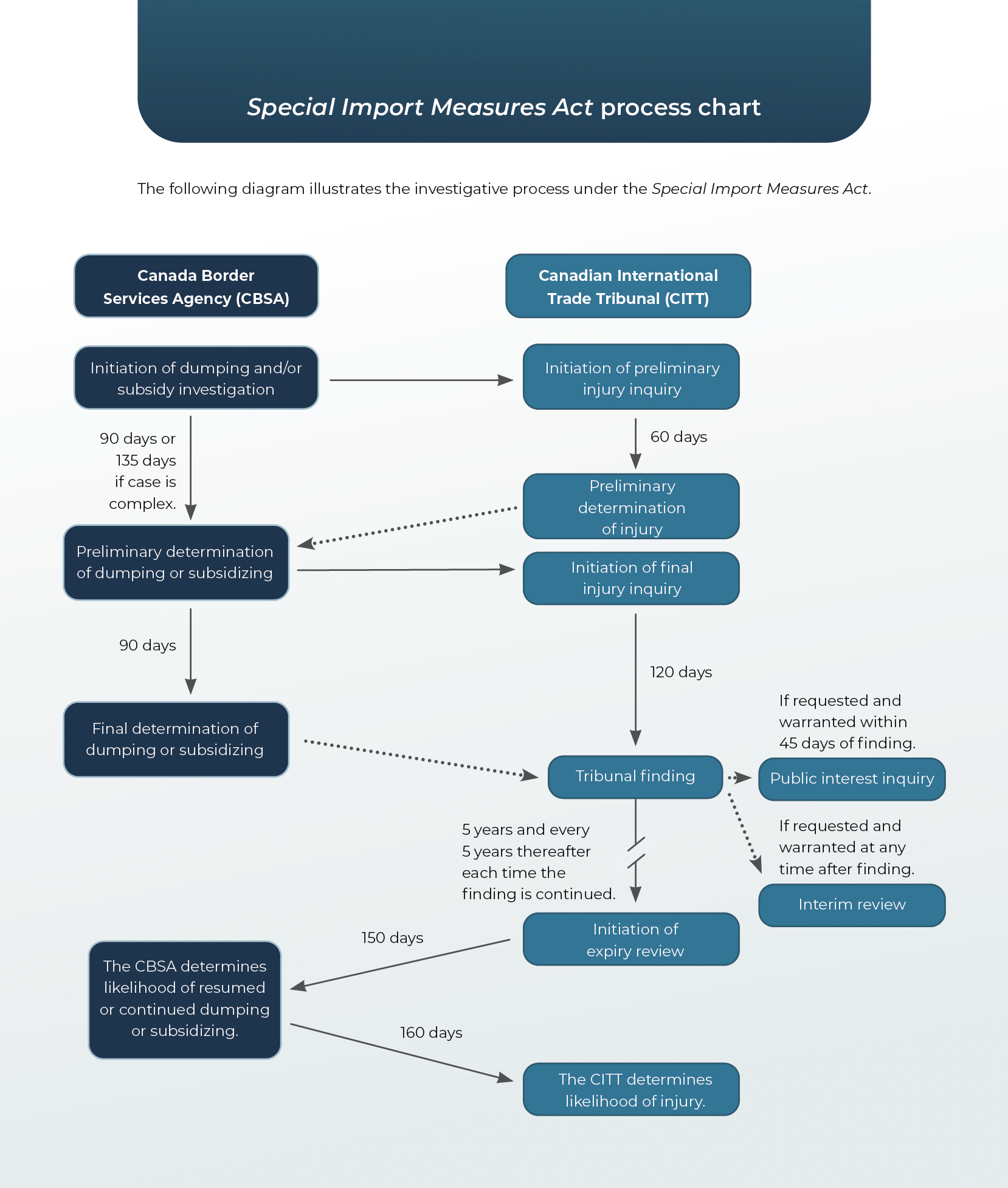
Details
From the date an investigation is initiated, the CBSA has 90 days (or 135 days if the case is complex) to either terminate the action or issue a preliminary determination.
The Tribunal, after the receipt of a notice of an initiation, conducts a preliminary injury inquiry. It must complete this inquiry within 60 days.
The CBSA makes a final determination regarding the dumping and subsidizing within a further 90 days.
The Tribunal’s final injury inquiry lasts 120 days and it must issue its finding within that timeframe.
Public interest inquiries can be initiated by the Tribunal itself or upon request from an interested party within 45 days of finding.
The Tribunal can initiate an interim review on its own or at the request of an interested party at any time after the issuance of the finding.
An expiry review must be initiated no later than five years after the Tribunal’s decision in the final injury inquiry or after the Tribunal’s decision in a previous expiry review.
Once an expiry review is initiated, the CBSA has 150 days to determine whether the expiry of the duties is likely to result in the continuation or resumption of dumping or subsidizing. If the CBSA determines that such likelihood exists, the Tribunal then has 160 days to conduct its inquiry to determine whether the expiry of the duties is likely to harm the domestic industry.
Injury inquiries
Preliminary injury inquiries (PI)
The CBSA generally initiates a dumping or subsidizing investigation following a complaint from a domestic producer. If the CBSA initiates a dumping or subsidizing investigation, the Tribunal initiates a preliminary injury inquiry under SIMA.
In a preliminary injury inquiry, the Tribunal determines whether the evidence discloses a reasonable indication that the dumping or subsidizing has caused injury or retardation or is threatening to cause injury.
If there’s no reasonable indication that the dumping or subsidizing has caused injury or retardation or is threatening to cause injury, the Tribunal terminates the inquiry, and the CBSA terminates the dumping or subsidizing investigation. The Tribunal issues a determination, within 60 days of the initiation of the preliminary injury inquiry, and reasons.
| PI-2023-002 | PI-2024-001 | PI-2024-002 | PI-2024-003 | PI-2024-004 | PI-2024-005 | |
|---|---|---|---|---|---|---|
| Product | Wire Rod | Pea Protein | Concrete Reinforcing Bar | Corrosion-resistant Steel Sheet | Renewable Diesel | Polyethylene Terephthalate |
| Type of case | Dumping | Dumping and subsidizing | Dumping | Dumping | Dumping and subsidizing | Dumping and subsidizing |
| Country or countries | China, Egypt and Vietnam | China | Bulgaria, Thailand and the United Arab Emirates | Türkiye | United States | China and Pakistan |
| Date of decision | May 7, 2024 | June 20, 2024 | July 2, 2024 | February 3, 2025 | N/A | N/A |
| Determination | Reasonable indication of injury | Reasonable indication of injury | Reasonable indication of injury | Reasonable indication of injury | Pending | Pending |
| Participants | ||||||
| 4 | 2 | 4 | 3 | 3 | 2 |
| 5 | 2 | 2 | 2 | 11 | 3 |
| 2 | 0 | 0 | 0 | 0 | 0 |
| Total | 11 | 4 | 6 | 5 | 14 | 5 |
Final injury inquiries (NQ)
If the CBSA makes a preliminary determination of dumping or subsidizing, the Tribunal commences a final injury inquiry pursuant to SIMA. The CBSA may levy provisional duties on imports from the date of the preliminary determination, and it continues its investigation until it makes a final determination of dumping or subsidizing.
The Tribunal must issue its finding of injury within 120 days from the date of the CBSA’s preliminary determination of dumping or subsidizing. The Tribunal has an additional 15 days to issue reasons supporting its finding. A Tribunal finding of injury or retardation or threat of injury to a domestic industry is required for the imposition of definitive anti-dumping or countervailing duties by the CBSA. The finding remains in place for up to five years.
| NQ-2024-001 | NQ-2024-002 | NQ-2024-003 | |
|---|---|---|---|
| Product | Wind Rod | Pea Protein | Concrete Reinforcing Bar |
| Type of case | Dumping | Dumping and subsidizing | Dumping |
| Country | China, Egypt and Vietnam | China | Bulgaria, Thailand and the United Arab Emirates |
| Date of finding | October 4, 2024 | November 19, 2024 | January 13, 2025 |
| Finding | Injury | Injury | Injury |
| Questionnaires received | 39 | 118 | 39 |
| Witnesses heard | 20 | 7 | 14 |
| Participants | |||
| 4 | 2 | 5 |
| 5 | 3 | 3 |
| 0 | 2 | 2 |
| Total | 9 | 7 | 10 |
Expiry reviews (RR)
The purpose of an expiry review is to determine whether the imposition of anti-dumping or countervailing duties remains necessary. There are two phases in an expiry review.
The first phase is the investigation by the CBSA to determine whether there is a likelihood of resumed or continued dumping or subsidizing if the order or finding expires.
If the CBSA determines that such likelihood exists with respect to any of the goods, the second phase is the Tribunal’s inquiry into the likelihood of injury or retardation arising from the resumption or continuation of the dumping or subsidizing. If the CBSA determines that there is no likelihood of resumed dumping or subsidizing for any of the goods, the Tribunal issues an order rescinding the order or finding with respect to those goods.
Upon completion of an expiry review, the Tribunal issues an order with reasons, rescinding or continuing an order or finding, with or without amendment. If an order or finding is continued, it remains in force for a further five years, unless an interim review is initiated, and the order or finding is rescinded. If the order or finding is rescinded, imports are no longer subject to anti dumping or countervailing duties.
The Tribunal also initiated five expiry reviews which were still in progress at the end of the fiscal year. These reviews concerned silicon metal, thermoelectric containers, circular copper tube, structural tubing, hot-rolled carbon steel plate (China) and aluminum extrusions.
| RR-2023-002 | RR-2023-003 | RR-2023-004 | RR-2023-005 | RR-2023-006 | RR-2023-007 | RR-2023-008 | RR-2023-009 | RR-2024-001 | RR-2024-006 | |
|---|---|---|---|---|---|---|---|---|---|---|
| Product | Hot-rolled Carbon Steel Plate | Carbon Steel Welded Pipe | Seamless Carbon or Alloy Steel Oil and Gas Well Casing | Sucker Rods | Cold-rolled Steel | Carbon Steel Welded Pipe | Corrosion-resistant Steel Sheet | Carbon Steel Welded Pipe | Unitized Wall Modules | Hot-Rolled Carbon Steel Plate and High-Strength Low‑Alloy Steel Plate |
| Type of case | Dumping | Dumping and subsidizing | Dumping and subsidizing | Dumping and subsidizing | Dumping and subsidizing | Dumping | Dumping | Dumping and subsidizing | Dumping and subsidizing | Dumping |
| Country | China | Chinese Taipei, India, Oman, Korea, Thailand and the United Arab Emirates | China | China | China, Korea and Vietnam | Pakistan, Philippines, Türkiye and Vietnam | China, Chinese Taipei, India and Korea | China | China | Bulgaria, Czech Republic and Romania |
| Date of decision | May 15, 2024 | June 26, 2024 | July 24, 2024 | August 21, 2024 | September 19, 2024 | October 16, 2024 | November 20, 2024 | December 24, 2024 | March 19, 2025 | March 20, 2025 |
| Decision | Order continued | Order continued | Order continued | Finding continued | Order continued | Finding continued | Finding continued | Order continued | Order continued | Order rescinded |
| Questionnaires received | 35 | 35 | 30 | 16 | 50 | 37 | 35 | 39 | 62 | 0 |
| Witnesses heard | 0 | 0 | 10 | 6 | 0 | 4 | 0 | 0 | 0 | 0 |
| Participants | ||||||||||
| 4 | 4 | 5 | 2 | 4 | 4 | 3 | 4 | 10 | 3 |
| 0 | 0 | 0 | 1 | 0 | 6 | 0 | 0 | 0 | 1 |
| 0 | 0 | 2 | 0 | 0 | 1 | 8 | 0 | 0 | 0 |
| Total number of participants | 4 | 4 | 7 | 3 | 4 | 11 | 11 | 4 | 10 | 4 |
| * “0” witnesses means that these expiry reviews had file hearings (hearing by way of written submissions). | ||||||||||
Historical trend: Dumping and subsidizing
The Tribunal continues to experience a long-term trend increase in SIMA-related activity. This is due, in part, to a challenging global trade environment and a high percentage of inquiries and reviews that result in the imposition or the continuation of trade remedy measures. The following graph shows the evolution of the number of injury inquiries initiated over the past decade.
Anti-dumping and countervailing findings must be reviewed every five years to determine whether the measures remain necessary. The number of expiry reviews completed each year has gradually increased over a ten-year period, from an average of just over four expiry reviews for the 2015-20 period to six for the 2020-25 period. As shown in the following graph, this creates a cyclical but gradual upward trend pressure on the caseload of the Tribunal. For example, there are now 52 injury findings in force
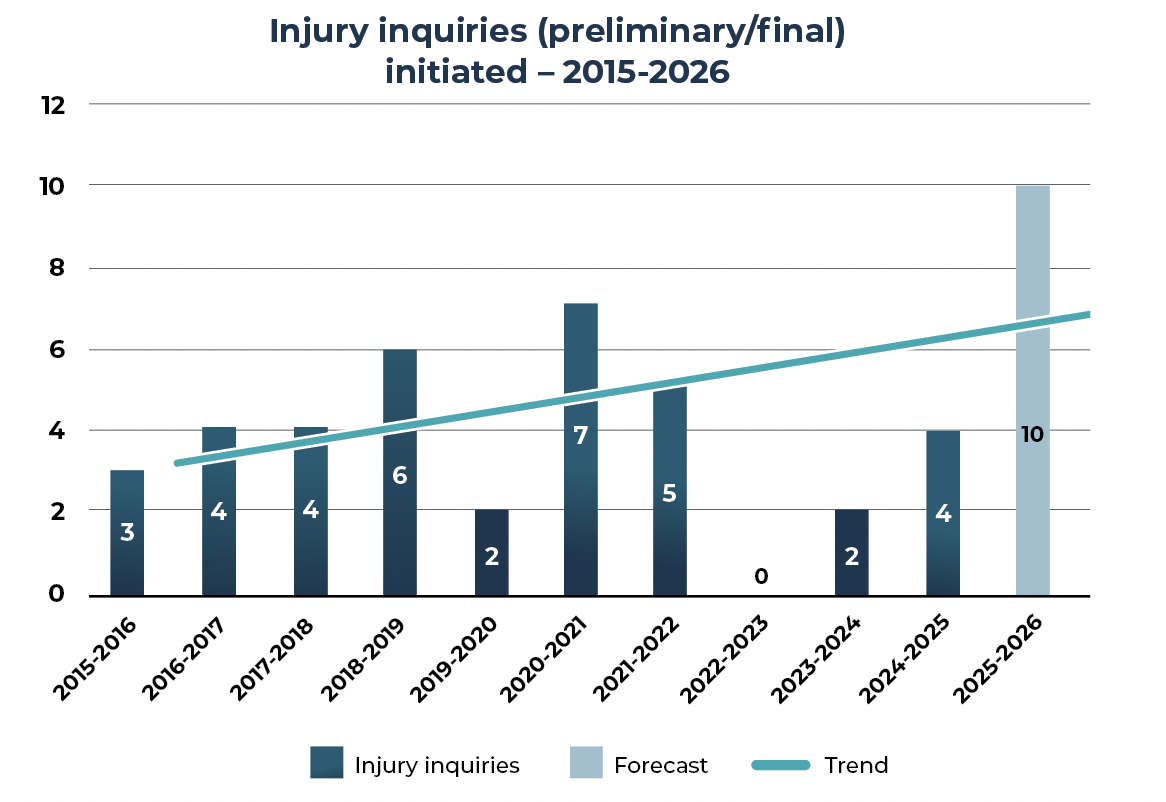
Details
Bar chart of injury inquiries from 2015 to 2026 and trend. The figure indicated for the 2025-2026 fiscal year is a forecast.
- 2015-2016: 3
- 2016-2017: 4
- 2017-2018: 4
- 2018-2019: 6
- 2019-2020: 2
- 2020-2021: 7
- 2021-2022: 5
- 2022-2023: 0
- 2023-2024: 2
- 2024-2025: 4
- 2025-2026: 10
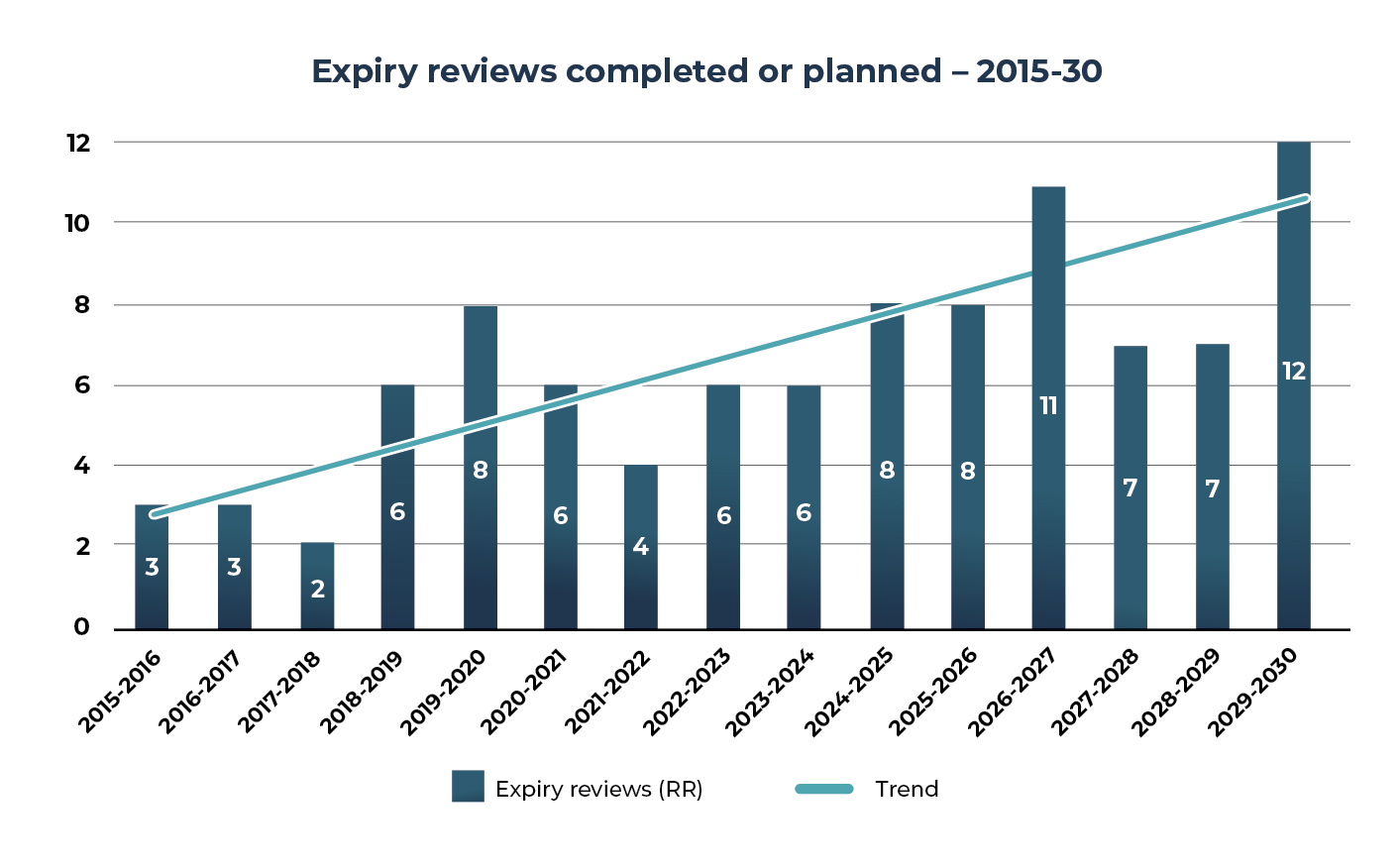
Details
Bar chart of expiry reviews from 2015 to 2030 and trend.
- 2015-2016: 3
- 2016-2017: 3
- 2017-2018: 2
- 2018-2019: 6
- 2019-2020: 8
- 2020-2021: 6
- 2021-2022: 4
- 2022-2023: 6
- 2023-2024: 6
- 2024-2025: 8
- 2025-2026: 8
- 2026-2027: 11
- 2027-2028: 7
- 2028-2029: 7
- 2029-2030: 12
Interim reviews (RD)
An interim review is when the Tribunal conducts an early review of its findings of injury or threat of injury, or other related orders at any time. It may be started on the Tribunal’s own initiative or at the request of the Minister of Finance, the CBSA or any other person or government.
An interim review may be warranted where there is a reasonable indication that new facts have arisen or if the circumstances that led to the finding or order have changed. In an interim review, the Tribunal determines if the finding or order (or any aspect of it) should be rescinded or continued to its expiry date, with or without amendment.
Public interest inquiries (PB)
At the request of an interested person or on its own initiative, the Tribunal may initiate a public interest inquiry following an injury finding if the Tribunal is of the opinion that there are reasonable grounds to consider that the imposition of all or part of the duties may not be in the public interest. In cases where it concludes that such duties are not in the public interest, the Tribunal will issue a report to the Minister of Finance recommending that the duties be reduced and by how much.
Noteworthy decisions under the dumping and subsidizing mandate
Corrosion-resistant Steel Sheet (RR-2023-008)
A decision which resulted in the initiation of contempt proceedings for the first time in the Tribunal’s history.
As part of this expiry review, the Tribunal sent questionnaires to various producers and importers. The responses are critical to the Tribunal’s review, as they inform a significant part of the investigation report. One questionnaire was sent to T.Co Metals LLC (T.Co), a non-resident importer to Canada that was identified as having imported a significant quantity of goods matching the subject goods’ description from a country not subject to the review. The questionnaire focused on the volumes and prices of those products with the same description, which were relevant to assessing market conditions during the review period.
T.Co did not respond to the questionnaire by the deadline. Despite several attempts by the Secretariat to the Tribunal to communicate with T.Co, it continued to ignore the Tribunal’s requests. Given that the requested information was likely relevant for the purposes of its review, the Tribunal issued a production order to T.Co requiring it to comply with the request by a fixed date. It also warned T.Co that enforcement procedures may follow. T.Co did not comply with the order, and the Tribunal issued a further order requiring T.Co to show cause why it should not be found in contempt.
It was only after the issuance of the show cause order that T.Co finally filed a questionnaire response. In an accompanying letter, T.Co apologized for its failure to comply with the request earlier. It explained that, for various internal reasons, other priorities took precedence, and it believed the requested information was not relevant, since the goods it imported in Canada were from a non-subject country. Due to non-extendable statutory deadlines, the Tribunal could not incorporate T.Co’s late response in the investigation report in a sufficiently procedurally fair manner.
The Tribunal conducted a hearing, and it ordered T.Co to show cause as to why it should not be found in contempt of the Tribunal’s order. During the hearing, T.Co apologized again and acknowledged that it was a mistake to dismiss the importance of the Tribunal’s order.
After the hearing, the Tribunal found T.Co in contempt of the Tribunal. While the Tribunal recognized that T.Co may have had competing business priorities, the Tribunal found that those reasons, among others, were not sufficient to excuse the failure to comply with the order. In the Tribunal’s finding of contempt, it considered the failure to comply with the order and its potential systemic consequences, such as on the Tribunal’s ability to fulfill its SIMA mandate, and T.Co’s subsequent apology and recognition of its mistake.
Pea Protein (NQ-2024-002)
An injury inquiry involving an innovative food product.
On December 4, 2024, the Tribunal issued its finding in inquiry NQ-2024-002, concerning the dumping and subsidizing of certain high protein content (HPC) pea protein, originating in or exported from China, following a complaint brought by Nutri-Pea GP Inc. (Nutri-Pea) and Roquette Canada Ltd. (Roquette), the only Canadian producers of HPC pea protein. HPC pea protein, derived from peas—including yellow and green field peas—can be consumed directly, but it is most often used as an ingredient in the manufacturing of other food and drink products. Notable applications include nutrition bars, sports and nutritional drinks such as protein shakes, and plant-based meat alternatives like burgers.
The inquiry revealed a significant increase in the volume of dumped and subsidized goods from China, particularly in the first half of 2024. These imports undercut domestic prices, suppressed price increases and led to lost sales and declining market share for the domestic industry. Despite increased domestic production with the arrival of Roquette, the domestic industry struggled to compete with the low-priced subject imports in the Canadian market. While Nutri-Pea lost market share due to competition from Chinese pea protein, Roquette was prevented from gaining a meaningful foothold in the Canadian market despite its significant investment in a state-of-the-art facility.
The Tribunal also examined other factors that could have contributed to the injury, such as decreased demand and domestic intra-industry competition, but found that these factors did not sufficiently sever the causal link between the dumping and subsidizing of the Chinese goods and the injury suffered by the domestic industry. The Tribunal found that the material injury suffered by the domestic industry was primarily caused by lost sales and market share resulting from price competition with the dumped and subsidized Chinese goods.
Corrosion-resistant Steel Sheet (PI-2024-003)
An injury inquiry conducted following a CBSA self-initiated investigation, rather than one triggered by a complaint from domestic producers.
The Tribunal conducted a preliminary injury inquiry to determine whether there was evidence that disclosed a reasonable indication that the alleged dumping of corrosion-resistant steel sheet (COR) from the Republic of Türkiye (Türkiye) by Borçelik Çelik Sanayi Ticaret A.Ş. (Borçelik) had caused injury or was threatening to cause injury to the domestic industry. There are currently other trade remedy measures in force with respect to COR imported from six jurisdictions, including Türkiye (for exporters other than Borçelik).
The Tribunal found that the evidence indicated a significant increase in imports of COR into Canada from Borçelik between 2022 and 2023. The domestic producers also provided convincing evidence of several instances where they lost sales and revenue on COR to Borçelik in Canada, because of price undercutting. In addition, the domestic producers’ performance on COR worsened in recent years, and there was a reasonable indication that this worsening in performance was the result of dumped COR from Borçelik. This led the Tribunal to determine that there was evidence that disclosed a reasonable indication that the dumping of COR by Borçelik had caused injury to the domestic industry. Following the CBSA’s preliminary determination, the Tribunal initiated its final injury inquiry, which was still underway at the end of the fiscal year.
Procurement reviews
To safeguard the integrity of the Government of Canada’s procurement processes, the Tribunal has been vested with the mandate of:
- inquiring into complaints by potential suppliers of goods or services to the federal government relating to designated contracts valued above certain monetary thresholds;
- determining whether procurement processes that are the subject of complaints complied with Canada’s obligations under certain trade agreements;
- considering issues such as whether bids were evaluated fairly;
- recommending remedies and awarding costs; and
- providing recommendations to federal government institutions about their procurement processes.
There are potentially up to three stages in the Tribunal’s consideration of a procurement complaint:
- Acceptance stage – Within five working days of receipt of a properly documented complaint, the Tribunal determines whether the complaint was filed within statutory deadlines, whether it concerns a procurement process subject to the Tribunal’s jurisdiction, and whether the complaint discloses a reasonable indication of breach of compliance with the trade agreements. If those conditions are met, the Tribunal may begin an inquiry.
- Inquiry stage – Inquiries must be completed within 45, 90 or 135 days, depending on the complexity of the matter. The Tribunal examines the complainant’s allegations, the submissions of the government institution involved in the matter, and in certain cases submissions by interested parties. If a complaint is valid, the Tribunal will recommend an appropriate remedy (for example, that a new solicitation be issued, the bids be re-evaluated, or the contract be terminated).
- Compensation stage – If a complaint is valid and the Tribunal recommends compensation (i.e., a monetary award), the Tribunal asks parties to negotiate a mutually agreed amount of compensation. If parties cannot agree on an amount, the Tribunal will receive submissions and decide on an appropriate amount of compensation.
Overview of the procurement complaint process
- A potential supplier has 10 working days after the day it becomes aware, or should have become aware, of the grounds (the reasons) for the complaint to file:
- a complaint with the Tribunal.
- an objection with the government institution that is awarding the contract. If the potential supplier can’t settle its objection with the government institution, it can still bring a complaint to the Tribunal within 10 working days of being informed that the government institution hasn’t addressed the objection to the liking of the potential supplier.
- The Tribunal reviews the complaint to determine whether it can accept it for inquiry. The potential supplier is notified within one week if the complaint is accepted for inquiry.
- If the complaint is accepted for inquiry, the government institution has 25 days to file the Government Institution Report, which is its response to the complaint.
- The complainant has 7 working days to provide comments on the report.
- In most cases, within 90 calendar days from its receipt, the Tribunal determines whether the complaint is valid, valid in part or not valid.
- If a party disagrees with the Tribunal’s findings, it can ask the Federal Court of Appeal to review the matter.
Relationship between the Tribunal and the Office of the Procurement Ombud
Since October 1, 2020, the Office of the Procurement Ombud (OPO) and the Tribunal have worked under a Memorandum of Understanding (MOU). The MOU aims to ease potential suppliers’ access to the complaint review system administered by both organizations. It also provides for continued cooperation between OPO and the Tribunal. The Tribunal and OPO have jurisdiction over procurement complaints brought by Canadian suppliers as follows:
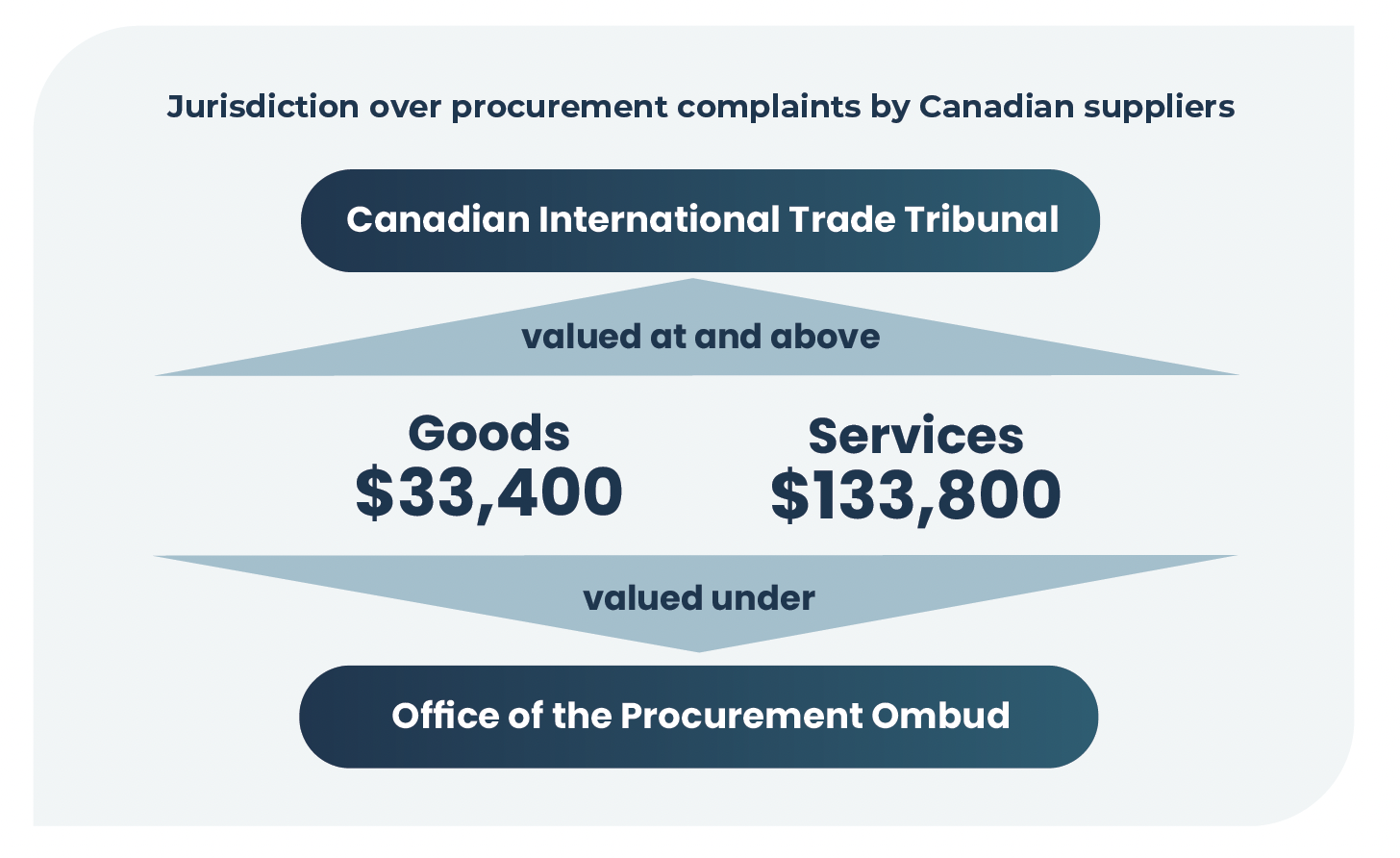
Details
Monetary thresholds over procurement complaints by Canadian suppliers.
The Tribunal has jurisdiction over procurement complaints for goods valued at $33,400 and above and OPO has jurisdiction for goods valued under $33,400.
The Tribunal has jurisdiction over procurement complaints for services valued at $133,800 and above and OPO has jurisdiction for services valued under $133,800.
The Tribunal has exclusive jurisdiction over complaints by foreign suppliers about government procurement processes under applicable trade agreements. When filing a complaint with either OPO or the Tribunal, complainants are given the option to share their contact information and the basic nature of their complaint with the other organization. This exchange enhances access to justice by ensuring that complainants are filing their complaints in the right place and, most importantly, in the timeliest manner possible. During this fiscal year, a majority of complainants used this service.
Officials from OPO and the Tribunal and its secretariat have continued to meet in 2024-25 to discuss each organization’s jurisdiction and how to ensure that parties have better access to justice.
Historical trend: Procurement complaints received
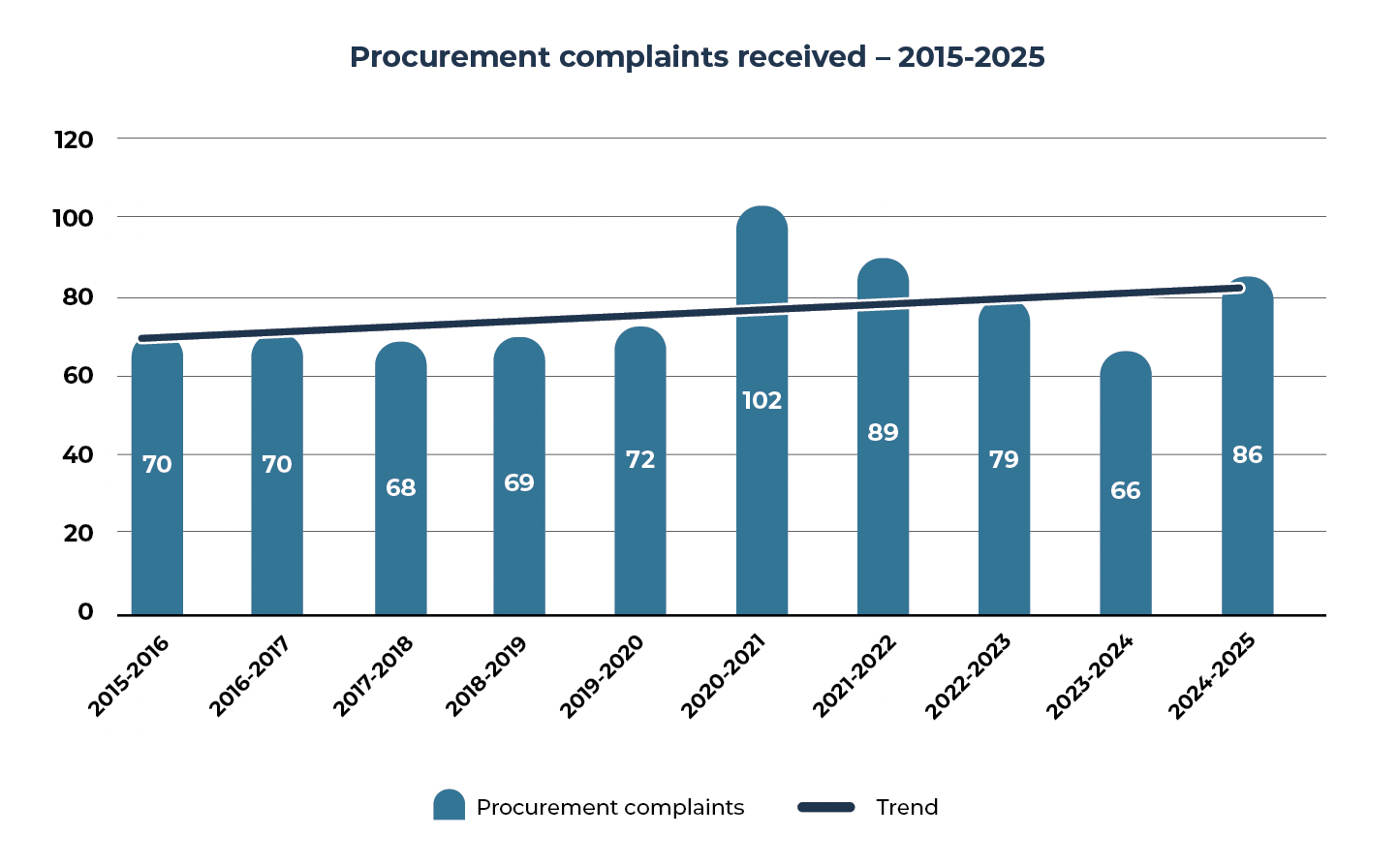
The Tribunal’s caseload for its procurement review mandate remains relatively consistent with historical trends for the last ten years.
Details
Bar chart of procurement complaints received from 2015 to 2025 and trend.
- 2015-2016: 70
- 2016-2017: 70
- 2017-2018: 68
- 2018-2019: 69
- 2019-2020: 72
- 2020-2021: 102
- 2021-2022: 89
- 2022-2023: 79
- 2023-2024: 66
- 2024-2025: 86
Procurement review activities in 2024-25
| Carried over from previous fiscal year | 7 |
|---|---|
| Received during this fiscal year | 86 |
| Total | 93 |
| Disposed during this fiscal year | 83 |
| Outstanding at the end of fiscal year | 10 |
| Total decisions issued | 41 |
|---|---|
| Premature/late filing | 20 |
| Lack of jurisdiction/not a potential supplier/not a designated contract | 4 |
| No reasonable indication of a breach | 17 |
| Withdrawn/abandoned | 8 |
| Total decisions issued | 34 |
|---|---|
| Ceased | 16 |
| Not valid/dismissed | 8 |
| Valid or valid in part | 10 |
Complaints received – self-represented parties
Of note, this year saw a continuation in a growing trend experienced by the Tribunal. Of the 86 complaints received this year, 64 were filed by self-represented parties. In that regard, to support such parties, the Tribunal’s website includes a set of guidelines describing the Tribunal’s procurement inquiry mandate and procedures. Potential complainants will also find on the Tribunal’s website a procurement complaint form, in multiple formats, with a comprehensive set of instructions that they can rely on to present their case to the Tribunal.
Compensation
Where the Tribunal determines that a procurement complaint is valid, it may recommend any remedy that it considers appropriate, including payment of compensation to the complainant. In cases where the Tribunal does not specify the amount of compensation to be paid, the Tribunal instructs the complainant and the government institution to negotiate that amount.
When the parties are unable to reach an agreement, the Tribunal receives submissions from the parties and establishes the final amount of compensation to be paid. The Tribunal issued one recommendation regarding compensation during this fiscal year in Chantier Davie Canada Inc. and Wärtsilä Canada Inc. v. Department of Public Works and Government Services (PR-2023-006). In three cases, parties reached a settlement on compensation, thus bringing these proceedings to a close.
| Carried over from previous fiscal year | 3 |
|---|---|
| Initiated during this fiscal year | 3 |
| Total | 6 |
| Disposed during this fiscal year | 4 |
| Ongoing at the end of fiscal year | 2 |
Noteworthy decisions under the procurement review mandate
White Bear Industries (PR-2024-044)
Can a bid be disqualified for alleged fraud without providing a clear account of the supporting facts in a procurement dispute?
This case relates to the disqualification by the Department of Public Works and Government Services (PWGSC) of a bid. To do so, it applied a clause (the rejection clause) that allowed it to disqualify a bid where there was, among other things, “evidence satisfactory to Canada” of fraud or fraudulent misrepresentation or evidence that, based on past conduct or behaviour, the bidder conducted itself improperly or is otherwise unsuitable. This was the first time the Tribunal was asked to consider a procuring entity’s rejection of a bid on the basis of allegations of fraud or misconduct relating to past performance. The complexity of the case required the Tribunal to hold a two-day hearing—an exceptional practice for the Tribunal in a procurement inquiry.
The complainant, White Bear Industries Ltd (WBI), is a family-owned business which has a long history of performing highway maintenance and repair work for both PWGSC and the British Columbia government. PWGSC disqualified WBI’s bid for the new solicitation by invoking the rejection clause, claiming that WBI had entered into unauthorized agreements under a previous, ongoing contract and had engaged in improper invoicing for those agreements.
The Tribunal noted that it does not have jurisdiction to decide on the agreements made under the previous contract. However, it concluded that it did have the jurisdiction to review PWGSC’s decision to disqualify WBI’s bid because that decision relates to bid evaluation within the procurement process. Bid disqualification under the rejection clause amounts to rejection for non-compliance with a mandatory requirement. It should be reviewed on the established deferential standard of reasonableness.
The Tribunal found the complaint to be valid, concluding that PWGSC had not provided a reasonable or tenable explanation for rejecting WBI’s bid. The rejection clause lists grounds for rejecting a bid that have legal meaning or counterparts as causes of action at common law. Those grounds are serious and pejorative, and they imply moral turpitude. Therefore, the Tribunal found that the phrase, “evidence satisfactory to Canada”, underpinning that clause meant evidence that is sufficiently probative and reliable to satisfy the civil standard of proof on a balance of probabilities. In the Tribunal’s view, PWGSC did not consider the relevant legal tests applicable to each of the grounds for rejection in the rejection clause, had not conducted a thorough factual investigation, and failed to provide WBI with fair notice of the allegations.
Oracle Canada ULC (PR-2024-015)
A complaint about how trade agreement rules were applied to pre-qualification in a complex, multi-stage procurement process.
Oracle Canada ULC (Oracle) filed three complaints with the Tribunal regarding a complex procurement process by Shared Services Canada (SSC) to provide public cloud computing services to the Government of Canada for many years. The complaints were submitted while the request for proposal (RFP) was still open and focused primarily on the selection criteria used in the fourth step of a twelve-step process to prequalify potential suppliers for the subsequent steps.
Oracle’s main grounds of complaint related to the limitation on the number of bidders selected at the end of the prequalification process, restrictions on suppliers’ ability to prequalify for subsequent stages based on the same selection criteria as those applied during the initial prequalification, and an alleged lack of transparency regarding the subsequent stages of the process. The Tribunal conducted its investigation concurrently with the progress of the RFP, with SSC publishing 26 amendments to the RFP to address the questions and comments from bidders, including Oracle. Some of Oracle’s grounds of complaint became moot because of these amendments.
The Tribunal recognized that SSC is entitled to use a multi-stage process for such a complex procurement but emphasized that the process must comply with the principles of openness, fairness and transparency. In this regard, the Tribunal recommended that SSC amend the RFP to explicitly allow any potential supplier to be added to the prequalification list in the future based on the same evaluation criteria as those selected. Furthermore, regarding transparency, the Tribunal recommended that SSC make public the final tender that will be issued at a later stage of the process.
After the investigation, the Tribunal received a separate complaint from a bidder that was not selected at the end of the prequalification process.
Fraser River Pile & Dredge (GP) Inc. (PR-2024-028)
Where a successful bidder in an initial procurement receives an advantage in a subsequent, related procurement process.
The complaint was about the second solicitation for a project to replace a wharf in Okeover, British Columbia. The project was divided into two solicitations: the first was for the fabrication, and the second was for the installation. Pacific Industrial & Marine Inc. (PIM) was awarded the fabrication solicitation, and then it bid on and was awarded the installation solicitation. Fraser River Pile & Dredge (GP) Ltd. (Fraser River) challenged that outcome. It had also bid on the installation solicitation but argued that it would have bid differently, or not at all, had it known that PIM was involved in the fabrication solicitation and that PIM could still bid on the installation solicitation despite its involvement in the first portion of the project. Fraser River argued that this was unfair.
The Tribunal found that PWGSC structured the two procurement processes in a way that created inextricable links between the fabrication and installation solicitations. As a result, when bidding on the second solicitation, PIM was already a prime actor in the wharf replacement project. The Tribunal found that knowledge of that information could reasonably have influenced or changed how a prudent business approached its bid. The Tribunal also found that bidders could reasonably have expected PWGSC to take certain actions or measures to prevent or mitigate any unfairness or perception of unfairness created by the circumstances, yet PWGSC took none. Consequently, Fraser River and other bidders had no way to consider PIM and its involvement in the fabrication solicitation when assessing the competitive landscape while developing their approach to the installation solicitation.
The Tribunal found the complaint valid and awarded Fraser River its bid preparation and complaint costs.
EBC Inc. (PR-2023-053)
A complaint examining the application of terms that permit the correction of bid submissions after the deadline, raising concerns about fairness and consistency in the procurement process.
EBC Inc. (EBC) filed a complaint with the Tribunal against PWGSC. The dispute arose from a government procurement process for construction management services. EBC claimed it was unfairly disqualified from the bidding process after PWGSC rejected its revised bid bond, which EBC submitted after the initial deadline but in response to a government request.
EBC submitted an electronic bid bond which was in a format that could not be verified, contrary to the terms of the request for proposal. Following the solicitation’s closing date, PWGSC requested that EBC re-submit the bond in a correct electronic format. EBC complied the same day, and PWGSC acknowledged receipt, saying no further action was needed. Months later, PWGSC notified EBC that its bid was disqualified for not meeting the original bid bond requirement.
EBC protested, arguing that PWGSC’s request for a new bond was permitted under the Phased Bid Compliance Process (PBCP), which allows the government to ask for missing information and for bidders to correct certain errors post-submission.
The Tribunal found that the terms of the solicitation allowed the government to request missing financial information (like a proper bid bond) and to accept corrected submissions. By explicitly requesting a corrected bid bond and giving EBC a deadline to do so, PWGSC triggered this process. Once EBC complied, the government was required to consider the new bond in evaluating the bid. The Tribunal noted that such a requirement is consistent with the underlying rationale of the PBCP, including its objectives of promoting competition and increasing bid compliance. The Tribunal ultimately found that, by ignoring the new bid bond, PWGSC violated both the terms of the request for proposal and fair procurement rules under trade agreements like the Canadian Free Trade Agreement.
Customs and excise appeals
The Tribunal hears and decides appeals of decisions of the President of the Canada Border Services Agency (CBSA) and the Minister of National Revenue.
1) Appeals filed under the Customs Act (AP)
Appeals filed under the Customs Act relate to a range of issues:
- appropriate classification of imports according to the Customs Tariff;
- appropriate manner in which to calculate the value for duty of imports;
- determination of where imports originated before they entered Canada; and
- importation of prohibited goods (such as certain pocketknives and weapons).
There were 32 appeals filed under the Customs Act in 2024-25.
2) Appeals filed under the Special Import Measures Act (EA)
Appeals filed under the Special Import Measures Act (SIMA) relate to two key issues:
- whether certain goods fall within the scope of trade remedy measures; and
- whether the CBSA properly calculated the margin of dumping, amount of subsidy or export price for certain imports.
Nine appeals were filed under SIMA in 2024-25.
3) Appeals filed under the Excise Tax Act (AP)
Appeals filed under the Excise Tax Act relate to an assessment or a determination of excise tax. No appeals were filed under this act in 2024-25.
4) Extensions of time (EP)
Under the Customs Act, a person may apply to the Tribunal for an extension of time to file a request for a re-determination or a further re-determination with the CBSA. The Tribunal may grant such an application after the CBSA has refused an application or when 90 days have elapsed after the application was made and the person has not been notified of the CBSA’s decision. A person may also apply to the Tribunal for an extension of time within which to file a notice of appeal.
There was one request for an extension of time filed before the Tribunal in 2024-25.
Appeals received, heard and scheduled
To ensure timely access to justice, the Tribunal schedules hearings immediately upon receipt of an appeal.
During the fiscal year, the Tribunal received 41 appeals. 59 appeal cases were outstanding at the end of the fiscal year. Of that number, 9 were in abeyance at the request of the parties, often because parties were attempting to negotiate a settlement or were awaiting the outcome of another related appeal before the Tribunal. The remaining 50 matters were all progressing.
| Cases brought forward from previous fiscal year | Cases received in fiscal year | Total | Total decisions issued | Cases withdrawn/ closed/no longer in abeyance | Cases outstanding (March 31, 2025) | |
|---|---|---|---|---|---|---|
| Customs Act (AP) | 35 | 32 | 67 | 17 | 9 | 41 |
In abeyance | 7 | 6 | ||||
Decision pending | 17 | 16 | ||||
Scheduled | 11 | 13 | ||||
To be scheduled | 0 | 6 | ||||
| Special Import Measures Act (EA) | 15 | 9 | 24 | 1 | 6 | 17 |
In abeyance | 7 | 3 | ||||
Decision pending | 5 | 7 | ||||
Scheduled | 3 | 3 | ||||
To be scheduled | 0 | 4 | ||||
| Excise Tax Act | 1 | 0 | 1 | 0 | 0 | 1 |
| Extension of time | 0 | 1 | 1 | 0 | 1 | 0 |
Noteworthy decisions under the customs and excise appeals mandate
American Standard Brands (d.b.a. Lixil Canada) and Andrew Sheret Purchasing Ltd. (AP-2021-031 and AP-2021-033)
Two appeals raising issues of abuse of process.
The appellants had agreed with the CBSA to pause the appeals while a similar case was being decided by the Tribunal: Wolseley Canada Inc. v. President of the Canada Border Services Agency (Wolseley). That case dealt with the tariff classification of identical and similar goods—electric bidet toilet seats.
The CBSA did not appeal the Tribunal’s decision in Wolseley. Instead, it sought to relitigate the issues in these appeals, arguing that the Wolseley decision was flawed. In particular, it advanced arguments relating to a Customs Tariff heading which it had failed to fully address in Wolseley.
The Tribunal found that the CBSA should not get a second chance to argue the same issue just because it did not put its best case forward in Wolseley. That would cause uncertainty, delays and extra expense to the appellants and the Tribunal.
The Tribunal refused to hear further arguments by the CBSA regarding the tariff classification and found that the goods should be classified under the same tariff classification as the Tribunal had determined in Wolseley. Applying the principles set out by the Federal Court of Appeal in Canada (Attorney General) v. Bri-Chem Supply Ltd., the Tribunal concluded that the CBSA’s attempt to relitigate issues already decided in Wolseley constituted an abuse of process, particularly since the CBSA had not appealed that ruling. An appeal to the Federal Court of Appeal was the proper avenue to contest the Tribunal’s decision in Wolseley.
In this decision, the Tribunal balanced the ability to challenge decisions with principles of certainty, predictability, finality and Tribunal pre-eminence, finding in the circumstances that the benefits of relitigating the issues did not outweigh the harm to these principles.
Judicial reviews and appeals
Judicial or panel reviews of Tribunal decisions
Any person affected by Tribunal findings or orders issued under the Special Import Measures Act (SIMA) can apply for judicial review by the Federal Court of Appeal (FCA) on grounds of, for instance, denial of natural justice or error of law. Any person affected by Tribunal procurement findings and recommendations under the Canadian International Trade Tribunal Act can similarly request judicial review by the FCA under sections 18.1 and 28 of the Federal Courts Act. Lastly, Tribunal orders and decisions made pursuant to the Customs Act can be appealed under that act to the FCA or, under the Excise Tax Act, to the Federal Court.
This year again, a small proportion (8 out of 196 or 4%) of the Tribunal decisions were appealed to a reviewing court.
Active at beginning of 2024-25 | Filed during 2024-25 | Disposed during 2024-25 | Outstanding at the end of 2024-25 | |||
|---|---|---|---|---|---|---|
Withdrawn | Allowed | Dismissed | ||||
| SIMA | 0 | 0 | 0 | 0 | 0 | 0 |
| Procurement | 1 | 6 | 2 | 0 | 1 | 4 |
| Appeals | 5 | 2 | 0 | 0 | 4 | 3 |
| Total | 6 | 8 | 2 | 0 | 5 | 7 |
Judicial reviews of Special Import Measures Act cases
There were no applications for judicial review filed before the FCA this fiscal year.
Judicial reviews of procurement complaints
There were six applications for judicial review of a decision by the Tribunal in a procurement complaint this fiscal year. Two of these applications were since discontinued by the applicant, and three remain outstanding at the end of the fiscal year.
| PR-2020-068 | PR-2024-024 | PR-2024-041 | PR-2024-015 | PR-2024-038 | PR-2024-044 | |
|---|---|---|---|---|---|---|
| Complainant | Heiltsuk Horizon Maritime Services Ltd./Horizon Maritime Services Ltd. | Hakson Safety Wears Inc. | Distribution Elite Canada Inc. | Oracle Canada ULC | ADGA Group Consultants Inc. | White Bear Industries Ltd. |
| Date of Tribunal’s decision | May 22, 2024 | July 16, 2024 | September 18, 2024 | October 9, 2024 | January 20, 2025 | February 5, 2025 |
| FCA court status | Pending | Pending | Discontinued | Discontinued | Pending | Pending |
Details
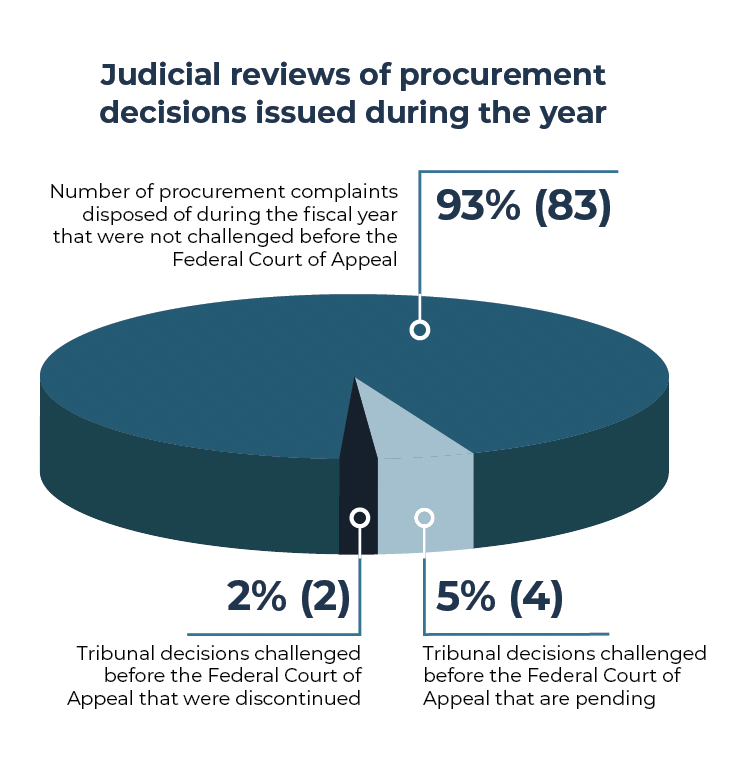
Pie chart of judicial reviews of procurement decisions issued during the fiscal year.
Of the 83 decisions issued by the Tribunal under this mandate, two were challenged before the Federal Court of Appeal and discontinued, and four were challenged before the Federal Court of Appeal and are pending.
During this fiscal year, one application for judicial review of a Tribunal decision filed in a previous fiscal year came to a close. The FCA dismissed the application for judicial review of the Tribunal’s decision in EllisDon Corporation v. Department of Public Works and Government Services (PR-2023-010).
Appeals of Customs Act and Special Import Measures Act appeal decisions
Two of the Tribunal’s decision under this mandate were challenged in the FCA this fiscal year.
| Appellant | B. Cooper |
|---|---|
| Date of Tribunal’s decision | October 2, 2024 |
| FCA court status | Pending |
Details
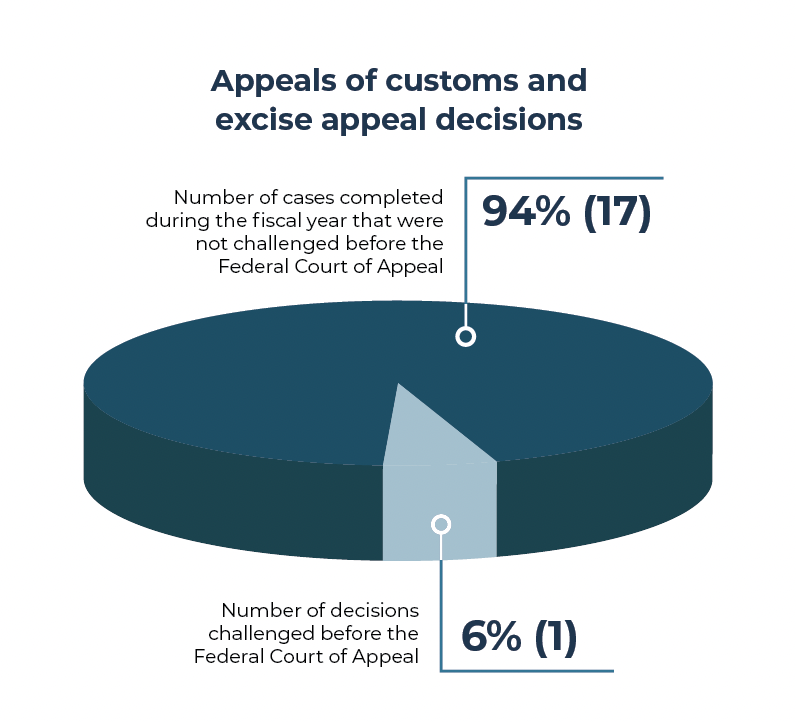
Pie chart of appeals of customs and excise appeal decisions during the fiscal year.
Of the 17 decisions issued by the Tribunal under this mandate, one was challenged before the Federal Court of Appeal.
During this fiscal year, the FCA dismissed appeals, filed in previous years, of Tribunal decisions in Charoen Pokphand Foods Canada Inc. v. President of the Canada Border Services Agency (AP-2021-008), Interpro Distributeurs de Viandes inc. v. President of the Canada Border Services Agency (AP-2020-030) and Best Buy Canada Ltd. v. President of the Canada Border Services Agency (AP-2022-015). The FCA also dismissed the separate application for judicial review related to the latter decision of the Tribunal, as well as the application for judicial review of the Tribunal’s decision in J. Byrne v. President of the Canada Border Services Agency (AP-2019-007).
Contact us
Canadian International Trade Tribunal
333 Laurier Avenue West, 17th Floor
Ottawa, Ontario K1A 0G7
Telephone: 613-993-3595
Toll-free: 1-855-307-2488
Fax: 613-990-2439
Email: citt-tcce@tribunal.gc.ca
Website: citt-tcce.gc.ca/en
Glossary
| Anti-dumping duties | Duties in the form of a tax on imported goods that were dumped on the Canadian market and subject to a finding of injury of the Tribunal. The application of anti-dumping duties is intended to offset the amount of dumping on imported goods and give the goods produced in Canada an opportunity to compete fairly with the imported goods. |
|---|---|
| Countervailing duties | Duties in the form of a tax on imported goods that were subsidized and subject to a finding of injury of the Tribunal. The application of countervailing duties is intended to offset the amount of subsidizing on imported goods and give the goods produced in Canada an opportunity to compete fairly with the imported goods. |
| Decision, determination, finding and order | A decision is a judgment made by the Tribunal in the context of its mandates, including on any matter that arises during a proceeding. A determination is a Tribunal decision resulting from a preliminary injury inquiry under the Special Import Measures Act (SIMA) or an inquiry into a procurement complaint. A finding is a Tribunal decision resulting from a final injury inquiry under SIMA. An order is a Tribunal decision resulting from an expiry, an expiry review or an interim review. It can also be a procedural decision in any type of case under the Tribunal’s mandates. |
| Designated contract | A contract for the supply of goods or services that has been or is proposed to be awarded by a government institution. |
| Judicial review | A review of a Tribunal decision by the Federal Court of Appeal or Federal Court. |
| Potential supplier | A bidder or prospective bidder on a designated contract. |
| Quasi-judicial | A partly judicial character by having the right to hold hearings on and conduct investigations into disputed claims and alleged infractions of statutes and to make decisions in the general manner of courts. |
| Remand (verb) | To send a case to another court. A party displeased with a Tribunal decision can ask the Federal Court of Appeal to overturn it. The Court can overturn that decision itself or refer it back (“remand it”) to the Tribunal with or without instructions on how it should decide the matter again. |
Annex
Orders and rulings issued in 2024-25
The tables below contain statistics pertaining to orders and rulings on procedural matters issued as part of the Tribunal’s proceedings during fiscal year 2024-25. These statistics illustrate the complexity of the cases considered by the Tribunal.
| Trade remedy activities | Procurement review activities | Appeals | Total | |
|---|---|---|---|---|
| Orders | ||||
| Disclosure orders | 17 | 0 | 0 | 17 |
| Cost award orders | N/A | 8 | N/A | 8 |
| Compensation orders | N/A | 1 | N/A | 1 |
| Production orders | 3 | 0 | 0 | 3 |
| Postponement of award orders | N/A | 11 | N/A | 11 |
| Rescission of postponement of award orders | N/A | 8 | N/A | 8 |
| Directions/administrative rulings | ||||
| Requests for information | 88 | 0 | 0 | 88 |
| Motions | 1 | 5 | 4 | 10 |
| Subpoenas | 2 | 0 | 0 | 2 |
Other statistics
| 2024-25 | 2023-24 | 2022-23 | 2021-22 | 2020-21 | |
|---|---|---|---|---|---|
| Public hearing days | 17 | 16 | 19 | 34 | 6 |
| File hearings | 11 | 4 | 7 | 18 | 18 |
| Witnesses | 61 | 54 | 73 | 111 | 0 |
| Participants | 106 | 53 | 71 | 204 | 189 |
| Questionnaire replies | 500 | 251 | 251 | 552 | 433 |
| Pages of official records | 370,913 | 178,495 | 210,227 | 287,196 | 324,035 |
| 2024-25 | 2023-24 | 2022-23 | 2021-22 | 2020-21 | |
|---|---|---|---|---|---|
| Public hearing days | 4 | 1 | 0 | 2 | 2 |
| File hearings | 61 | 55 | 73 | 87 | 77 |
| Witnesses | 8 | 0 | 0 | 1 | 0 |
| Participants | 115 | 88 | 111 | 158 | 153 |
| Questionnaire replies | 0 | 0 | 0 | N/A | 0 |
| Pages of official records | 55,693 | 55,416 | 73,473 | 86,255 | 90,754 |
| 2024-25 | 2023-24 | 2022-23 | 2021-22 | 2020-21 | |
|---|---|---|---|---|---|
| Public hearing days | 11 | 25 | 15 | 16 | 9 |
| File hearings | 10 | 14 | 10 | 6 | 5 |
| Witnesses | 12 | 34 | 14 | 19 | 13 |
| Participants | 70 | 133 | 86 | 86 | 76 |
| Questionnaire replies | 0 | 0 | 0 | N/A | 0 |
| Pages of official records | 17,326 | 48,376 | 54,263 | 27,193 | 15,596 |
| 2024-25 | 2023-24 | 2022-23 | 2021-22 | 2020-21 | |
|---|---|---|---|---|---|
| Public hearing days | 32 | 42 | 34 | 52 | 17 |
| File hearings | 82 | 73 | 90 | 111 | 100 |
| Witnesses | 81 | 88 | 87 | 131 | 13 |
| Participants | 291 | 274 | 267 | 448 | 418 |
| Questionnaire replies | 500 | 251 | 251 | 552 | 433 |
| Pages of official records | 478,993 | 282,287 | 337,963 | 400,644 | 432,132 |