
Dumping and subsidizing injury inquiries and expiry reviews
Under the Special Import Measures Act (SIMA), the Canada Border Services Agency (CBSA) may impose anti-dumping and countervailing duties if Canadian producers are injured by imports of goods into Canada:
- that have been sold at prices lower than the price of similar goods in the foreign producer’s home market or at prices that do not cover costs and a reasonable amount for profits (dumping); or
- that have benefited from certain types of government grants or other assistance from foreign governments (subsidizing).
The CBSA makes the determination as to whether dumping and subsidizing has occurred. The Tribunal determines whether such dumping or subsidizing has caused, or is threatening to cause, injury to a domestic industry or has caused delay to the establishment of a domestic industry.
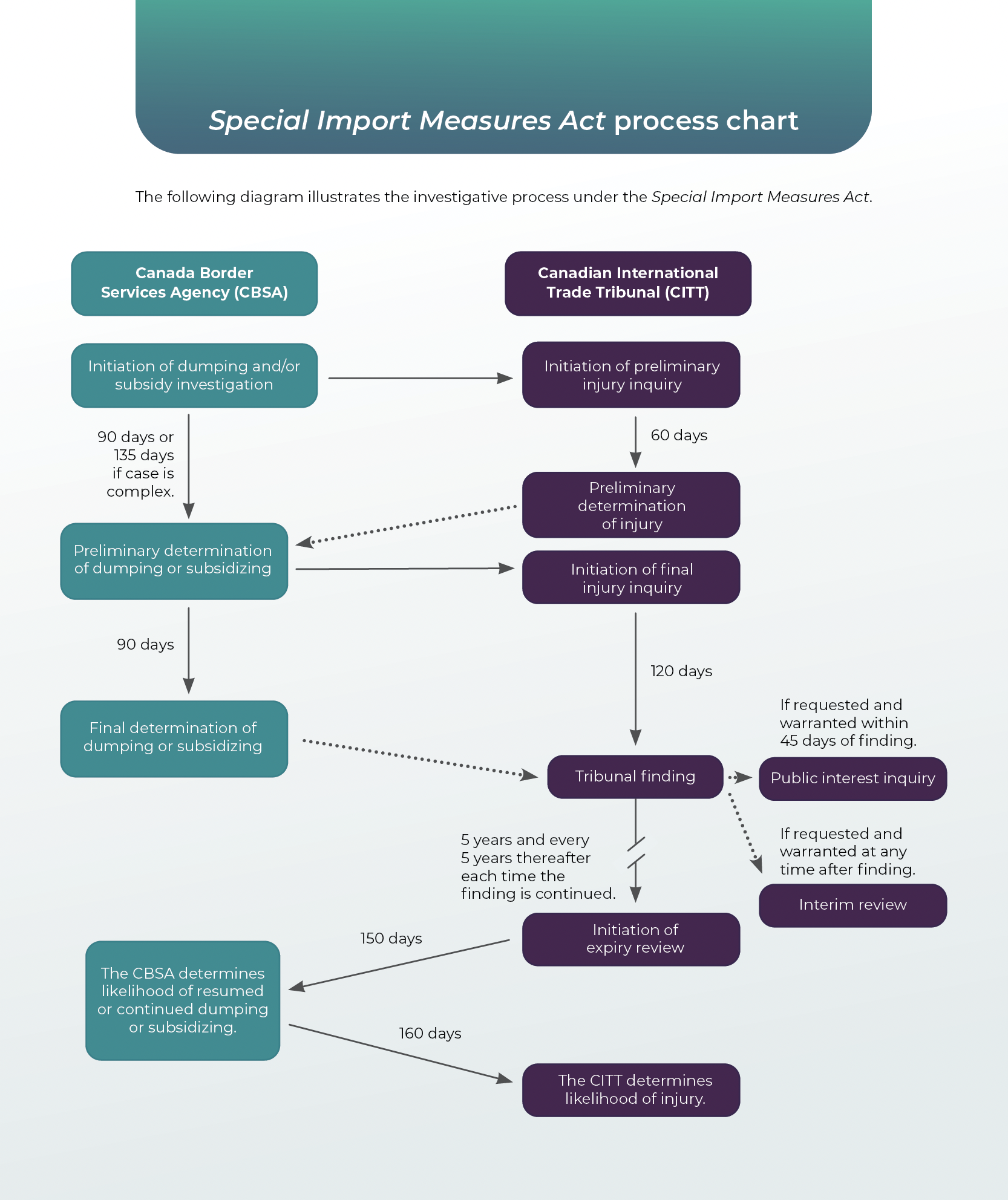
Special Import Measures Act process chart
Details
From the date an investigation is initiated, the CBSA has 90 days (or 135 days if the case is complex) to either terminate the action or issue a preliminary determination.
The Tribunal, after the receipt of a notice of an initiation, conducts a preliminary injury inquiry. It must complete this inquiry within 60 days.
The CBSA makes a final determination regarding the dumping and subsidizing within a further 90 days.
The Tribunal’s final injury inquiry lasts 120 days and it must issue its finding within that timeframe.
Public interest inquiries can be initiated by the Tribunal itself or upon request from an interested party within 45 days of finding.
The Tribunal can initiate an interim review on its own or at the request of an interested party at any time after the issuance of the finding.
An expiry review must be initiated no later than five years after the Tribunal’s decision in the final injury inquiry or after the Tribunal’s decision in a previous expiry review.
Once an expiry review is initiated, the CBSA has 150 days to determine whether the expiry of the duties is likely to result in the continuation or resumption of dumping or subsidizing. If the CBSA determines that such likelihood exists, the Tribunal then has 160 days to conduct its inquiry to determine whether the expiry of the duties is likely to harm the domestic industry
Injury inquiries
Preliminary injury inquiries (PI)
The CBSA generally initiates a dumping or subsidizing investigation following a complaint from a domestic producer. If the CBSA initiates a dumping or subsidizing investigation, the Tribunal initiates a preliminary injury inquiry under SIMA.
In a preliminary injury inquiry, the Tribunal determines whether the evidence discloses a reasonable indication that the dumping or subsidizing has caused injury or retardation or is threatening to cause injury.
If there’s no reasonable indication that the dumping or subsidizing has caused injury or retardation or is threatening to cause injury, the Tribunal terminates the inquiry, and the CBSA terminates the dumping or subsidizing investigation. The Tribunal issues a determination and reasons.
The Tribunal completed one preliminary injury inquiry concerning certain wind towers during the fiscal year. Another preliminary injury inquiry, concerning certain wire rod, was initiated and is ongoing at the end of the fiscal year.
| PI-2023-001 | PI-2023-002 | |
|---|---|---|
| Product | Wind Towers | Wire Rod |
| Type of case | Dumping and subsidizing | Dumping |
| Country or countries | China | China, Egypt and Vietnam |
| Date of decision | June 20, 2023 | N/A |
| Determination | Reasonable indication of injury | Pending |
| Participants | ||
• in support of the complaint | 1 | |
• opposed to the complaint | 2 | |
• no views expressed | 4 | |
| Total | 7 | |
Final injury inquiries (NQ)
If the CBSA makes a preliminary determination of dumping or subsidizing, the Tribunal commences a final injury inquiry pursuant to SIMA. The CBSA may levy provisional duties on imports from the date of the preliminary determination, and it continues its investigation until it makes a final determination of dumping or subsidizing.
The Tribunal must issue its finding of injury within 120 days from the date of the CBSA’s preliminary determination of dumping or subsidizing. The Tribunal has an additional 15 days to issue reasons supporting its finding. A Tribunal finding of injury or retardation or threat of injury to a domestic industry is required for the imposition of anti-dumping or countervailing duties by the CBSA. The finding remains in place for up to five years.
The Tribunal initiated and completed one final injury inquiry this fiscal year concerning certain wind towers.
| NQ-2023-001 | |
|---|---|
| Product | Wind Towers |
| Type of case | Dumping and subsidizing |
| Country | China |
| Date of finding | November 17, 2023 |
| Finding | Injury |
| Questionnaires received | 7 |
| Witnesses heard | 13 |
| Participants | |
• in support of the complaint | 2 |
• opposed to the complaint | 5 |
• no views expressed | 3 |
| Total | 10 |
Expiry reviews (RR)
The purpose of an expiry review is to determine whether the imposition of anti-dumping or countervailing duties remains necessary. There are two phases in an expiry review.
The first phase is the investigation by the CBSA to determine whether there is a likelihood of resumed or continued dumping or subsidizing if the order or finding expires.
If the CBSA determines that such likelihood exists with respect to any of the goods, the second phase is the Tribunal’s inquiry into the likelihood of injury or retardation arising from the resumption or continuation of the dumping or subsidizing. If the CBSA determines that there is no likelihood of resumed dumping or subsidizing for any of the goods, the Tribunal does not consider the goods in its subsequent determination of the likelihood of injury, and it issues an order rescinding the order or finding with respect to those goods.
Upon completion of an expiry review, the Tribunal issues an order with reasons, rescinding or continuing an order or finding, with or without amendment. If an order or finding is continued, it remains in force for a further five years, unless an interim review is initiated and the order or finding is rescinded. If the order or finding is rescinded, imports are no longer subject to anti dumping or countervailing duties.
The Tribunal completed six expiry reviews in the fiscal year concerning line pipe, stainless steel sinks, copper pipe fittings, liquid dielectric transformers, steel piling pipe and dry wheat pasta.
The Tribunal also initiated eight expiry reviews which were still in progress at the end of the fiscal year. These reviews concerned steel plate, seamless casing, sucker rods, cold-rolled steel, corrosion-resistant steel sheet and carbon steel welded pipe (three separate findings).
| RR-2022-001 | RR-2022-002 | RR-2022-003 | RR-2022-004 | RR-2022-005 | RR-2023-001 | |
|---|---|---|---|---|---|---|
| Product | Carbon and Alloy Steel Line Pipe | Stainless Steel Sinks | Copper Pipe Fittings | Liquid Dielectric Transformers | Steel Piling Pipe | Dry Wheat Pasta |
| Type of case | Dumping | Dumping and subsidizing | Dumping and subsidizing | Dumping | Dumping and subsidizing | Dumping and subsidizing |
| Country | South Korea | China | Vietnam | South Korea | China | Türkiye |
| Date of decision | September 6, 2023 | October 4, 2023 | November 22, 2023 | December 20, 2023 | January 17, 2024 | March 20, 2024 |
| Decision | Finding continued | Order continued | Finding continued | Order continued | Order continued | Finding continued |
| Questionnaires received | 29 | 18 | 18 | 19 | 13 | 19 |
| Witnesses heard | 15 | 0* | 5 | 21 | 0* | 0* |
| Participants | ||||||
• in support of the continuation | 5 | 2 | 2 | 6 | 4 | 7 |
• opposed to the continuation | 0 | 0 | 0 | 1 | 0 | 2 |
• no views expressed | 5 | 0 | 1 | 0 | 1 | 0 |
| Total number of participants | 10 | 2 | 3 | 7 | 5 | 9 |
* “0” witnesses means that these expiry reviews had file hearings (hearing by way of written submissions).
Historical trend: Expiry reviews
While the number of inquiries in fiscal year 2023-24 was lower than in previous years, the Tribunal continues to experience a long-term trend increase in SIMA-related activity. This is due, in part, to a challenging global trade environment and a high percentage of inquiries and reviews that result in the imposition or the continuation of trade remedy measures.
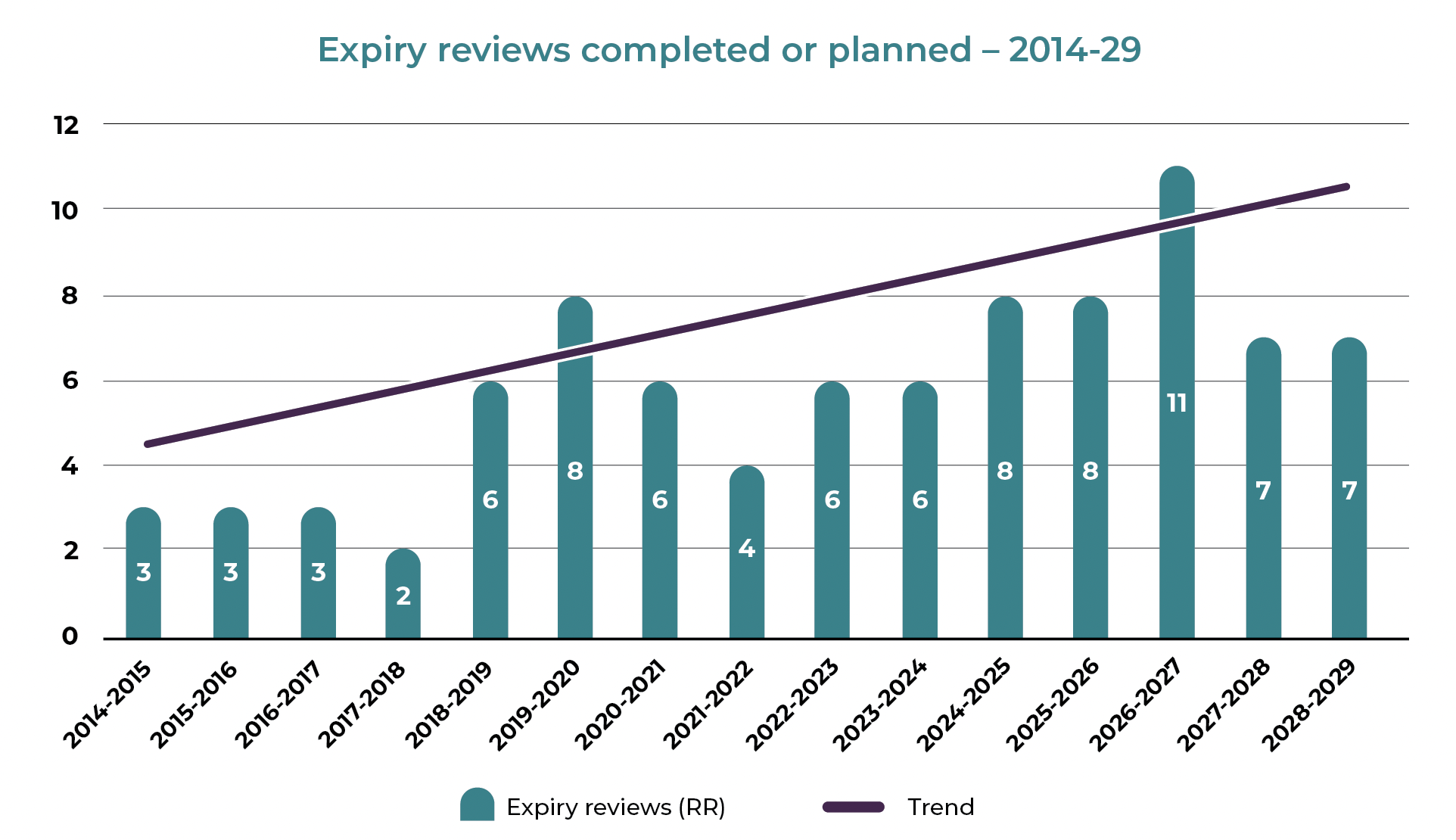
Anti-dumping and countervailing findings must be reviewed every five years to determine whether the measures remain necessary. The number of expiry reviews completed each year has gradually increased over a ten-year period, from an average of just over three expiry reviews for the 2014-19 period to six for the 2019-24 period. As shown in the following graph, this creates a cyclical but gradual upward trend pressure on the caseload of the Tribunal. For example, there are now 50 injury findings in force
Details
Bar chart of expiry reviews from 2014 to 2029 and trend.
- 2014-2015: 3
- 2015-2016: 3
- 2016-2017: 3
- 2017-2018: 2
- 2018-2019: 6
- 2019-2020: 8
- 2020-2021: 6
- 2021-2022: 4
- 2022-2023: 6
- 2023-2024: 6
- 2024-2025: 8
- 2025-2026: 8
- 2026-2027: 11
- 2027-2028: 7
- 2028-2029: 7
Interim reviews (RD)
An interim review is when the Tribunal conducts an early review of its findings of injury or threat of injury, or other related orders at any time. It may be started on the Tribunal’s own initiative or at the request of the Minister of Finance, the CBSA or any other person or government.
An interim review may be warranted where there is a reasonable indication that new facts have arisen or if the circumstances that led to the finding or order have changed. In an interim review, the Tribunal determines if the finding or order (or any aspect of it) should be rescinded or continued to its expiry date, with or without amendment.
The Tribunal received a request for an interim review of its finding concerning photovoltaic modules and laminates. This request remains under consideration at the end of the fiscal year.
Sample of noteworthy decisions under the Special Import Measures Act mandate
Wind Towers (NQ-2023-001)
On November 17, 2023, the Tribunal issued its finding in inquiry NQ-2023-001 about the dumping and subsidizing of certain steel utility wind towers and their sections originating in or exported from China. The complaint was brought by Marmen Inc., the only Canadian producer of wind towers located in Quebec.
The purpose of the Tribunal’s inquiry was to determine whether imports of wind towers from China caused material injury to Marmen. Wind towers are purchased, on a project-by-project basis, by original equipment manufacturers (OEMs) of wind turbines who then assemble and install the towers and turbines at the project site.
The Tribunal examined available bid information for each project and found that the Chinese wind towers were priced significantly lower than wind towers manufactured in Canada and offered by Marmen to OEMs. On that basis alone, it might appear that this price undercutting caused the injury claimed by Marmen during the period of inquiry. However, other evidence showed that the situation was more complicated.
Wind towers are very large and heavy products. Complex logistics are needed to transport a wind tower from the manufacturing facility to the installation site. OEMs are typically responsible for making both transportation arrangements and paying the cost of transport and associated logistics.
After reviewing large volumes of evidence and arguments, the Tribunal concluded that OEMs carefully consider both cost and reliability of transportation logistics when determining transportation routing from the production facility to the project site. In some instances, OEMs may exhibit a preference for an established transportation method that had been used reliably for previous projects.
For wind projects located in western Canada, the Tribunal found that Marmen was disadvantaged, with respect to both cost and increased logistical complexity, in bidding to supply projects located at geographically distant locations from its production facilities. The logistics of transporting wind towers by land from Quebec to western Canada involved disadvantages that were not faced by wind towers imported from China that were transported by sea from China to ports on the West Coast.
Thus, the Tribunal found that, with respect to projects in Western Canada, factors other than dumping and subsidizing greatly complicated the connection between the dumping and subsidizing of the wind towers imported from China and contributed to the injury suffered by Marmen.
On the other hand, transportation logistics were less of a relevant factor when assessing the effect of dumping and subsidizing with respect to competition between Chinese and domestic wind towers for the supply of project sites that are geographically closer to Marmen’s production facilities. In at least one instance, regarding a project located in Quebec, the Tribunal found a strong connection between the dumping and subsidizing of the wind towers imported from China and consequential material injury to Marmen.
As a result, the Tribunal found that the dumping and subsidizing of the Chinese wind towers had caused material injury to the domestic industry. However, the Tribunal limited its finding by excluding Chinese wind towers imported for installation in energy projects located west of the Ontario-Manitoba border.
Liquid Dielectric Transformers (RR-2022-004)
The Tribunal conducted an expiry review to determine whether to continue its order concerning the dumping of large power transformers (LPTs) originating in or exported from the Republic of Korea. These transformers are liquid dielectric transformers and have a top power handling capacity equal to or exceeding 60,000 kilovolt amperes, whether assembled or unassembled and complete or incomplete.
Domestic producers, the United Steel Workers and Unifor supported the continuation of the order. HD Hyundai Electric Co., Ltd., a foreign producer of LPTs, opposed the continuation of the order.
The Tribunal concluded that Korean producers likely have enough capacity to increase exports to Canada and would likely try to find as many export opportunities as possible, including in the Canadian market if the Tribunal allowed the order to expire. Moreover, the nature of LPTs as capital goods (that is, goods that are “made to order” once a sale is made) and how this affects the offer, sale and delivery of LPTs would mean that prices would likely decline before import volumes increased if the order were allowed to expire.
The Tribunal also found that the market for LPTs is less open and transparent than the markets of many products that are bought and sold publicly such as commodities. During its investigation, the Tribunal noted that the value of bids could vary greatly among suppliers, partly because they often inaccurately estimated their competitors’ prices. This led to domestic producers bidding lower than necessary to compete effectively.
Thus, if the order expires, there would likely be a significant increase in the volume of Korean LPTs offered at prices lower than those of domestic producers. This, combined with the limited price transparency in the LPT market, would depress prices in the Canadian market. Consequently, the Tribunal found that, without the order, the domestic industry’s sales and financial situation would be materially worse.
In its assessment of likely injury in this expiry review, the Tribunal also considered the potential impacts the absence of this order may have on workers employed in the transformer industry. The Tribunal found that, if the order expired, there could be a significant negative effect on employment and workers. The domestic producers may need to reduce their workforce if they lose sales. This will significantly impact an industry that strongly depends on highly trained and skilled employees.
Decisions that considered impacts on workers
In June 2022, the Special Import Measures Act was amended to provide that assessments of injury must take into account impacts on workers employed in the domestic industry. The Special Import Measures Regulations were also amended to include several new factors for the Tribunal to consider when making those assessments, including the effects on hiring, employment levels, and the terms and conditions of employment of workers (e.g., wages, hours worked, pension plans and benefits). These amendments applied to all inquiries and expiry reviews initiated after June 2022. Therefore, the Tribunal considered the new regulatory factors in expiry reviews that concluded during this fiscal year, especially in Carbon and Alloy Steel Line Pipe (RR-2022-001), Copper Pipe Fittings (RR-2022-003) and Liquid Dielectric Transformers (RR-2022-004).